
How Many Days Till March 8?
Calendar
Countdown chart
The exact answer is in the live countdown at the top of this page, which reads your own device clock and time zone. If you want to verify it yourself, the fastest method is to subtract the start date’s day-of-year number from the year’s length, then add 67 (March 8 is the 67th day of a common year).
Counters often disagree by a day or two, and the reason is rarely a bug. It usually comes down to whether the start day, the end day or both are counted, and which time zone the page uses. The sections below show how to count, so you can tell which answer you actually need.
Why two counters can show different answers
Compare a few countdown pages and you will see totals that differ by one, and weekday totals that differ by several. Three things cause almost all of it. Some pages count the end date as a full day, some measure to the start of March 8 and some to its end. Some use the server’s time zone instead of yours. And weekday counts may or may not include the final day.
For an event on March 8, measure to the start of the day, in your own time zone. That is the moment you care about if you are counting down to a morning plan, a deadline at midnight or a celebration that begins at dawn. If your plan ends at the close of March 8, add one day to the figure.
Counting by hand with day-of-year numbers
Month-by-month addition works, but day-of-year numbers are quicker and harder to get wrong. March 8 is day 67 of a common year (31 + 28 + 8) and day 68 of a leap year. Every date has a similar number, and a handy anchor is that March 1 is day 60 in a common year and day 61 in a leap year.
If you start in the year before March 8, the formula is: (days in the start year minus the start date’s day number) plus 67. If you start in January or February of the same year, it is simply 67 minus your day number. The leap day only counts when February 29 lies between your start and March 8, which means the leap status of the target year matters for starts in the same year, and the leap status of the start year matters for the remainder of December.
A worked example with a hypothetical start date
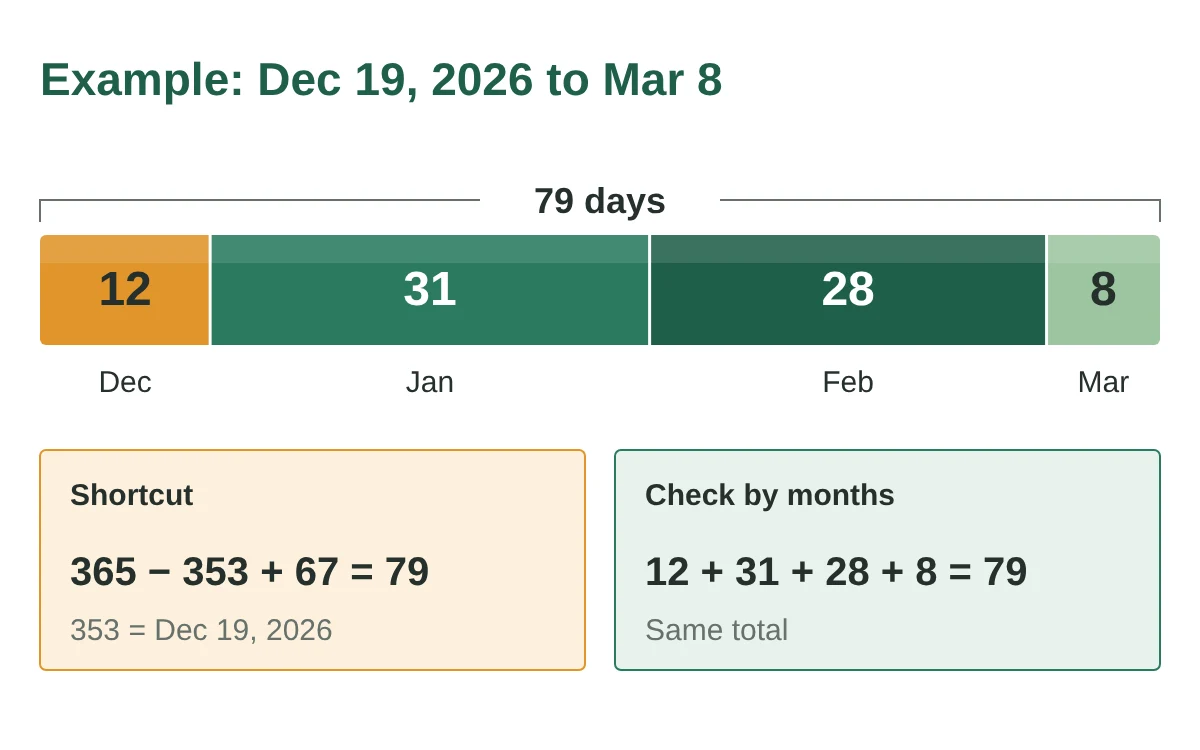
Suppose you start counting on December 19, 2026 (a made-up starting point, not today). December 19 is day 353 of 2026. The year has 365 days, so 365 minus 353 leaves 12 days to the end of December. Add 67 for March 8, 2027, and the total is 79 days.
Check it the slow way: 12 days left in December, plus 31 in January, plus 28 in February, plus 8 in March also gives 79. Two methods agreeing is the best error check available, and it takes ten seconds. For any other start or end pair, the date calculator does the same subtraction instantly.
Try this: Pick any date in the next month, work out its day-of-year number from memory using the month-start anchors (Jan 0, Feb 31, Mar 59, Apr 90, May 120, Jun 151), then run the formula above and compare it with the widget.
Weeks and weekdays to March 8
Dividing by 7 gives weeks and a remainder, and the remainder is where weekday counts are decided. Using the 79 days from the example: that is 11 weeks and 2 days. Each full week holds exactly 5 weekdays, so 11 weeks contribute 55. Then look only at the 2 leftover days, which are the two days just before March 8 (counting March 8 itself, excluding the start day).
In 2027 March 8 is a Monday, so the leftover days are Sunday and Monday. Only Monday is a weekday, which makes 56. Because the target is a Monday, the weekend always sits right before it, so a “start of the work week” deadline has no working days to spare on the final weekend. Public holidays then come off that total, and they vary by country. A weeks-only figure is easier to turn into milestones, and how many days are in 8 weeks is useful for setting prep blocks.
Which March 8 you are counting to
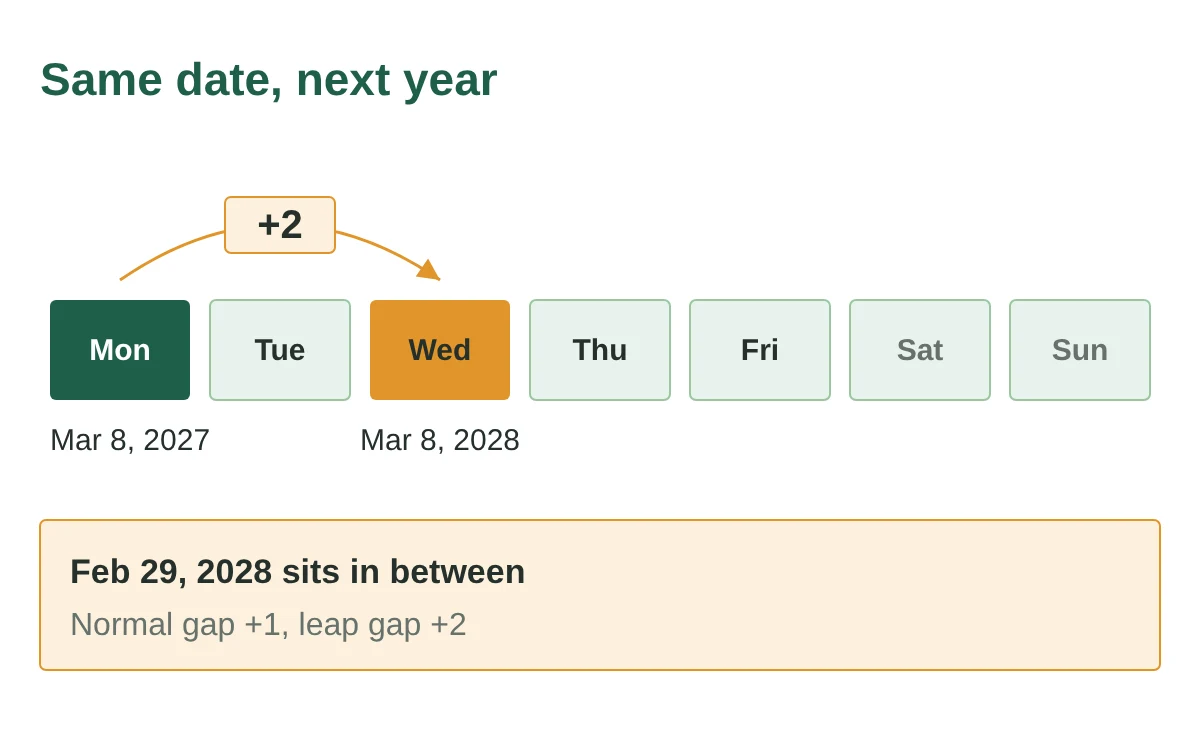
The widget targets the next March 8 and rolls forward after the date passes. The weekday does not repeat from year to year: it advances by one each year, and by two when a February 29 sits in between. That is why March 8, 2027 is a Monday and March 8, 2028 is a Wednesday.
This matters for planning. A date that lands on a weekend one year may fall on a workday the next, and a leap-year gap is 366 days between anniversaries instead of 365. If you are counting to a March 8 more than a year away, use the exact target year in the date calculator rather than dividing 365 into the gap.
What March 8 is known for
March 8 is International Women’s Day. The first observances took place in 1911 in a handful of European countries, and the United Nations began marking the day in 1975, then invited member states to adopt a day for women’s rights and peace in 1977. It is a public holiday in a number of countries, including Russia and several former Soviet states, and in the German state of Berlin.
In Italy, the day is Festa della Donna, and the custom is to give yellow mimosa flowers. Date format is a common stumbling block when you search or share it: 3/8 means March 8 in the US, but 3/8 reads as 3 August in much of the world, where the day comes first. Write “8 March” in invitations to avoid confusion.
Seasonally, March 8 falls in meteorological spring in the Northern Hemisphere, which begins March 1, but before the astronomical equinox around March 20. If you are also counting to the first day of spring, the March 20, 2027 countdown covers it.
March 8 and the clock change
In the United States, daylight saving time begins on the second Sunday in March, so the earliest it can start is March 8 itself. When March 8 lands on a Sunday, that day has only 23 hours. In 2027 the change comes later, on March 14, so a countdown to March 8 does not cross it. A countdown to March 14 does not either, but one to later dates will.
The practical lesson is that counters which divide total hours by 24 can drift by a day across the change, while counters that compare calendar dates do not. If you ever see a countdown showing a half-day offset in March, this is the usual cause.
Planning backwards from March 8
Counting down is most useful when you convert it into checkpoints. Working backwards from a fixed date prevents the last-week crush:
- Set the deadline for anything that needs lead time (printing, shipping, bookings) at 4 to 6 weeks out.
- Set a draft or decision milestone at 21 days out, which leaves a buffer.
- Set a final confirmation 3 days before, as March 8 weekdays fill quickly.
To find the dates for these milestones, count back from March 8 rather than forward from today. For a longer planning arc, 90 days before a date is a handy kick-off point, and starting from March 1 gives you a natural one-week mark.
Try this: Write down March 8 and subtract 7, 14 and 21 days on paper. Note the weekday each lands on, and move any that fall on a weekend to the Friday before.
Frequently asked questions
How many days are there from today to March 8?
The live counter above the article gives the exact figure for your own clock and time zone. To check it by hand, subtract today's day-of-year number from the year's length and add 67 (or 68 if the March 8 in question falls in a leap year).
What day of the week is March 8?
It changes every year. The weekday moves forward one day each year and two days after a leap year, so March 8, 2027 is a Monday and March 8, 2028 is a Wednesday.
Is March 8 the 67th day of the year?
Yes in a common year, because January has 31 days, February 28 and March 8 adds 8. In a leap year it is the 68th day, since February has 29.
Does the countdown reach zero on March 8 or the day before?
It depends on the counter. Counters that measure to the start of March 8 show zero at midnight as the day begins, while some count the whole day and only finish at the end. The live widget on this page counts to local midnight at the start of March 8.