
How Many Days Until March 20, 2027?
Calendar
Countdown chart
The exact number of days until March 20, 2027 is shown in the live countdown above this article, calculated from your own clock and time zone. It counts to the first moment of Saturday, March 20, 2027, so the answer reaches zero at midnight on Friday night, not at the end of the day.
The rest of this page covers what a quick count tends to get wrong: time zone edges, a daylight saving quirk, working-day arithmetic for a Saturday target, and a way to verify any answer on paper in under a minute.
Why two countdowns can disagree
Two sites can both be correct and still show different numbers. The cause is the finish line. A countdown aimed at 00:00 on March 20 reaches zero as Friday ends. One aimed at 23:59 on March 20 runs a full day longer. Some tools also round partial days down, others up, so a count of 100 days and 7 hours may appear as 100 or 101.
Your time zone matters as well. A tool fixed to one city’s clock will show a different answer from your local one for part of every day. The widget on this page uses your device’s clock, so its answer is the one that matches your own calendar.
Count it by hand with the day-of-year method
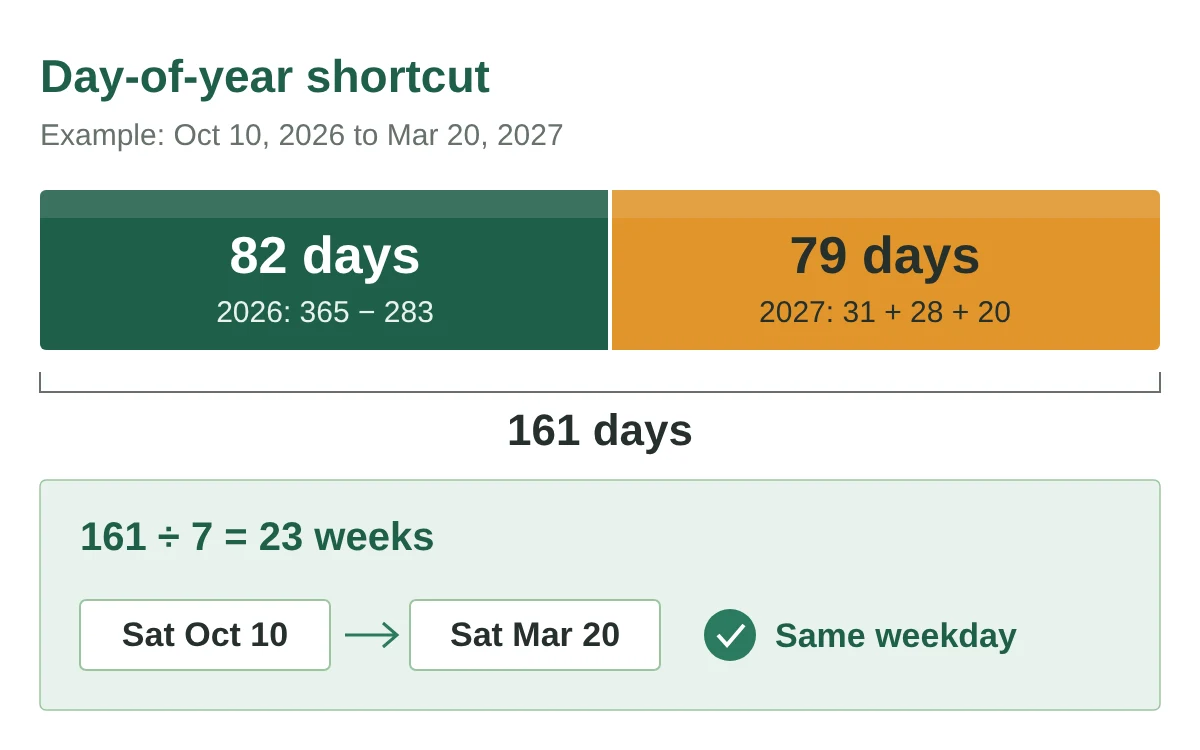
The fastest manual method avoids counting months. March 20 is day 79 of 2027, because January (31) plus February (28) plus 20 gives 79, and 2027 is not a leap year, so there is no February 29 to trip over. Find your start date’s day of the year, subtract it from the year’s length, then add 79.
Here is a worked example with a hypothetical start of October 10, 2026:
- Days in January to September 2026: 31 + 28 + 31 + 30 + 31 + 30 + 31 + 31 + 30 = 273.
- October 10 is day 283 of 2026.
- Days left in 2026: 365 minus 283 = 82.
- Add 79 for 2027 to get 161 days.
161 is exactly 23 weeks, which gives a free check: the start and target must fall on the same weekday. October 10, 2026 is a Saturday, and so is March 20, 2027. If the remainder after dividing by 7 does not match the weekday gap, a month length went wrong somewhere.
Try this: Pick any date in the next month, run the day-of-year method, then divide your total by 7. Check that the remainder equals the weekday shift between the two dates.
The daylight saving trap in hour counts
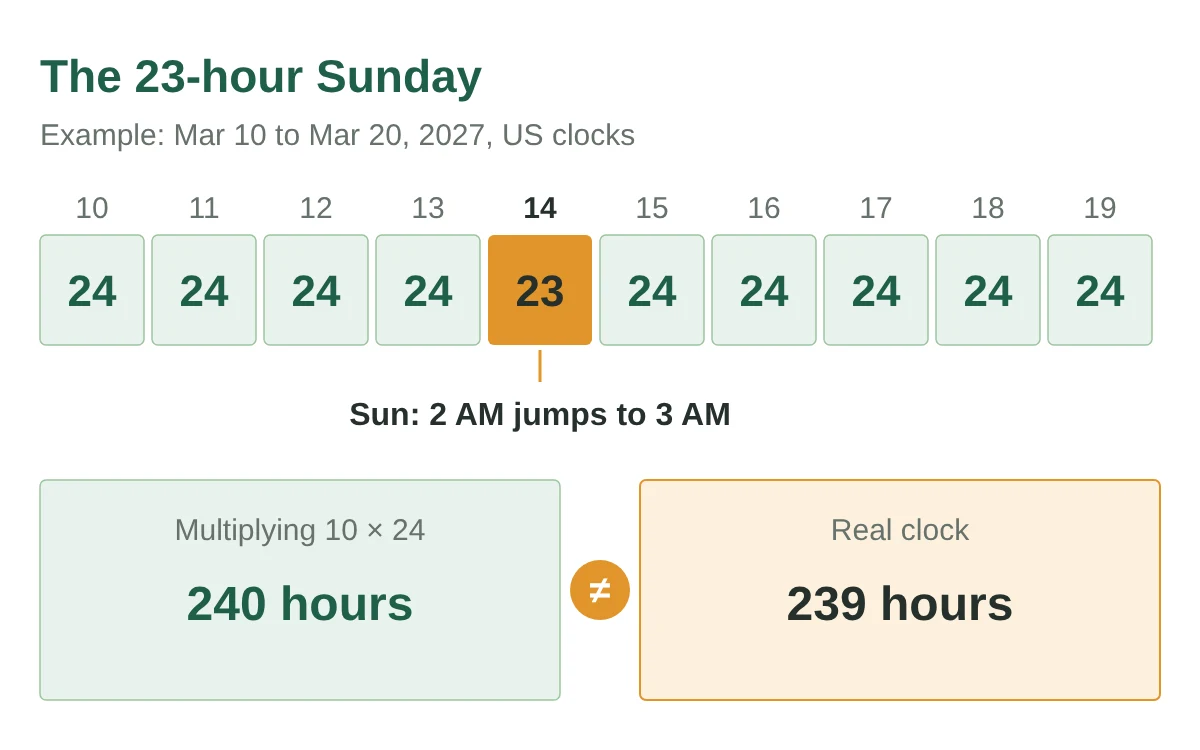
A day count is a calendar count, so clock changes do not touch it. An hour count is different. In the US, clocks spring forward on Sunday, March 14, 2027, six days before the target. Anyone in a US time zone who multiplies days by 24 will overshoot by one hour, because that Sunday has only 23 hours.
In Europe the change happens later, on March 28, after the target date, so European countdowns to March 20 are not affected. If you ever see an hours figure that is not a neat multiple of 24 from a US start date before March 14, this is why. It is also a reason to trust a tool that reads real clock time rather than one that multiplies.
Counting working days to a Saturday
A Saturday target means Friday, March 19 is the last working day you get. Counting weekdays by hand is quick: multiply full weeks by 5, then count the leftover days one at a time. In the example above, 161 days is exactly 23 weeks, and counting from Sunday, October 11 through Friday, March 19 gives 115 weekdays.
Public holidays are the usual gap. Most lists of working days count every Monday to Friday, so remove holidays that apply to you, such as Presidents’ Day, Christmas or New Year’s Day, by hand. Weekends in the window are simply the days left over once weekdays are subtracted.
Spreadsheet formulas that don’t misfire
In Excel or Google Sheets, =DATE(2027,3,20)-TODAY() returns the day count. If the cell shows a strange date such as January 1900, the cell is formatted as a date; switch it to a plain number. For working days, =NETWORKDAYS(TODAY(),DATE(2027,3,20)) counts both endpoints when they are weekdays, and an optional third argument takes a range of holiday dates to exclude.
TODAY() ignores the time of day, so a spreadsheet gives a whole number while the live widget gives a precise figure down to the second. For a deadline that matters to the hour, use the widget or the date calculator, which handles start and end dates of your choice.
Try this: In a spare cell, type the NETWORKDAYS formula above and compare its answer to your own weekday count. Any gap is usually a holiday or an off-by-one at an endpoint.
What actually happens on March 20, 2027
The March equinox arrives at 20:25 UTC on March 20, 2027, according to the US Naval Observatory’s 2027 table. That is 4:25 PM Eastern and 1:25 PM Pacific. Some sources round it to 20:24, which is a one-minute difference in how the instant is computed.
The date is not the same everywhere. In Sydney the equinox falls on March 21 at 07:25, and in Auckland on March 21 at 09:25. One planetary instant, two calendar dates. It also begins autumn, not spring, in the Southern Hemisphere.
The equinox also anchors the Easter calculation. The first full moon after it is on March 22, so the first Sunday after that is March 28, which makes Easter 2027 an early one. If you are planning around it, the March 28 countdown is a useful companion.
Nearby dates worth comparing
Because March 20, 2027 is a Saturday, people often plan around the days either side of it. The March 19 countdown shows the Friday before, and the March 21 countdown shows the Sunday after. For a longer view, the January 1, 2027 countdown gives you a checkpoint roughly 11 weeks earlier.
To turn a day count into other units, the 8 weeks to days page shows the week arithmetic, and the 120 days to months page explains why months are an unreliable unit for planning, since they run from 28 to 31 days.
Frequently asked questions
What day of the week is March 20, 2027?
It is a Saturday. That means the last working day before it is Friday, March 19, and the countdown reaches zero at the very start of the weekend.
Is March 20, 2027 the first day of spring?
Astronomically, yes in the Northern Hemisphere: the March equinox falls on that date in UTC and in all US time zones. In Australia and New Zealand the same moment lands on March 21 local time, and there it marks the start of autumn.
Does the daylight saving change affect the countdown?
The day count is unaffected, but a total in hours is. In the US, clocks spring forward on March 14, 2027, so any hour-based countdown that crosses that date is one hour shorter than days multiplied by 24.
What is the Excel or Google Sheets formula for days until March 20, 2027?
Use =DATE(2027,3,20)-TODAY() and format the cell as a number, not a date. For working days only, use =NETWORKDAYS(TODAY(),DATE(2027,3,20)).