
How Many Days Until March 19th?
Calendar
Countdown chart
The live countdown above gives the exact answer for your clock and time zone, down to the second. It always targets the next March 19, so once the date passes it rolls over to the following year without any change on your side.
If you want to check it yourself, the method takes about ten seconds and has one trap, which is whether the target day counts. The sections below cover that, plus weekdays, the leap year catch and what the date means in different countries.
How to count it by hand
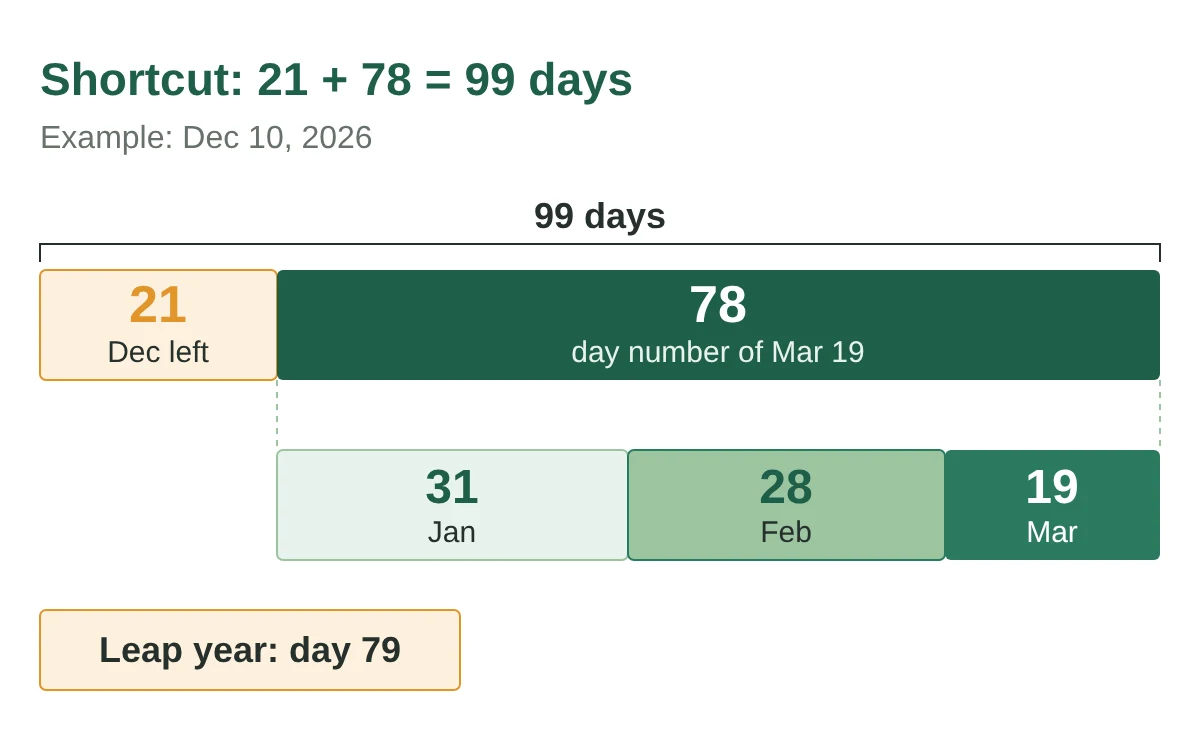
Work in month chunks instead of counting days one at a time. Take the days left in your current month, add the full months in between, then add 19. Use a hypothetical start of December 10, 2026:
- Days left in December: 31 minus 10 is 21.
- All of January: 31.
- All of February (2027 is not a leap year): 28.
- March 19: 19.
The total is 21 + 31 + 28 + 19 = 99 days. The shortcut is to remember that March 19 is day 78 of a normal year (day 79 in a leap year). Your start date’s day number subtracted from 78 gives the answer when both fall in the same year. For a start date in the previous year, add the days that year had left.
Try this: Pick any date in the next month and run the chunk method, then check it against the widget. Doing it once makes the logic stick, and you will catch any off-by-one habit straight away.
The off-by-one problem
Most disagreements between countdown tools come from whether today is counted. Subtracting dates (March 19 minus today) counts the nights you have to sleep through. Counting inclusively adds one, which suits something like a trip where both the first and last day are used.
Time zones add a second layer. A countdown ends at the start of March 19 in your location, so at 11 pm on March 18 the true remaining time is one hour, though a rounded display might show 1 day or 0 days depending on the tool. For the hours near the end, see how long until midnight.
Counting weekdays and weeks
For weekdays, take whole weeks and multiply by 5, then walk through only the leftover days. With the hypothetical 99 days above, that is 14 weeks and 1 leftover day. The 14 weeks give 70 weekdays. The leftover day is March 19 itself, a Friday in 2027, so it adds one more if you count the target. The total is 70 weekdays before it or 71 including it.
Because the leftover is just a remainder from dividing by 7, the leftover days always land on the same weekdays as the target. This means that when the total divides evenly by 7, the countdown starts on the same weekday as March 19. For quick week conversions, 8 weeks to days shows the reverse direction.
Public holidays are the part no formula handles for you. The weekday count above ignores them, so subtract any that fall in your region between now and the target.
Which weekday March 19 lands on
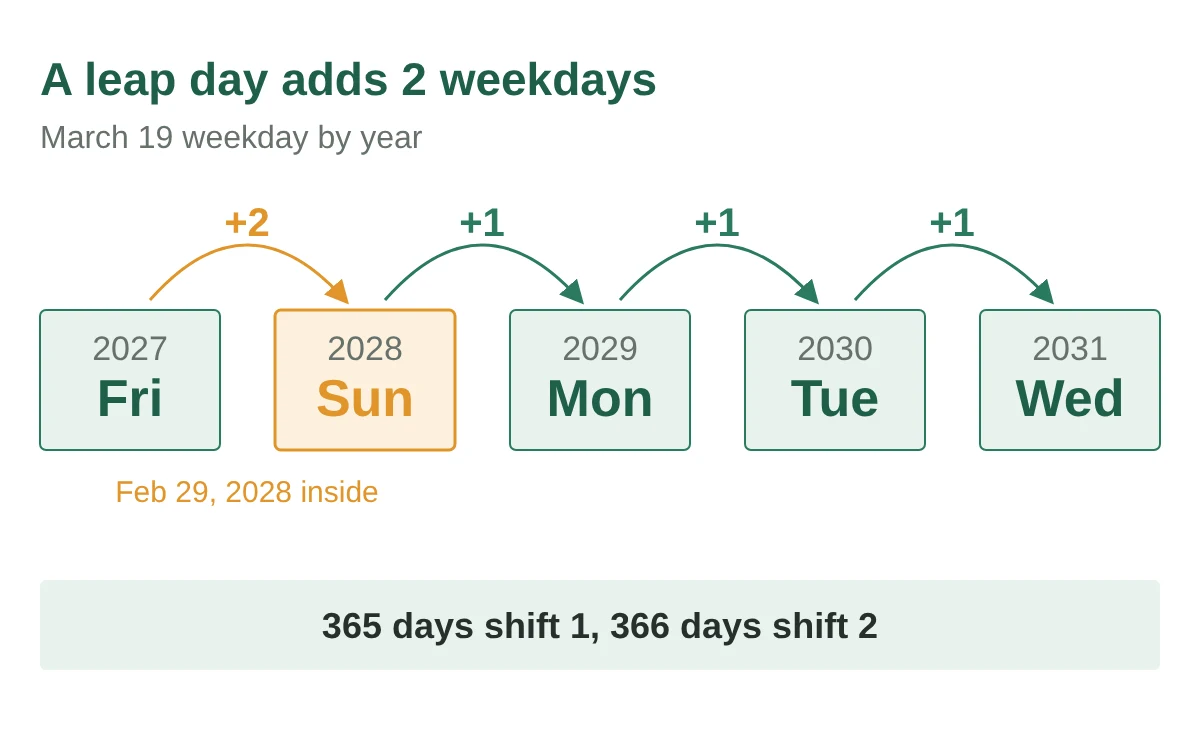
The weekday moves forward by one each year, and by two when a February 29 sits in between. That gives Friday in 2027, then Sunday in 2028 (the leap year jump), Monday in 2029, Tuesday in 2030 and Wednesday in 2031. The pattern repeats on a 28 year cycle in most centuries.
The leap day also changes your count. Any countdown that crosses February 29, 2028 is one day longer than the same span in another year, so a rule of thumb like “about 100 days” is safest when a leap year is not involved. If you are comparing a neighbouring date, March 20, 2027 sits one day later in the same year.
What March 19 is known for
The Catholic Church marks the Solemnity of St. Joseph on March 19. In several countries it doubles as Father’s Day, including Spain, Italy and Portugal. When March 19 falls on a Sunday during Lent, as it does in 2028, the observance normally shifts to the Monday.
In Valencia, Spain, the Las Fallas festival climaxes on the night of March 19 with the burning of the large papier-mâché sculptures. In California, Mission San Juan Capistrano has long linked the date to the return of its famous swallows, with festivities around St. Joseph’s Day.
Astronomically, March 19 is usually a day or two before the spring equinox, which falls on March 20 or 21 in most years. It was the equinox date in parts of the Americas in 2020, but that is rare. March 19 is not a standard tax or school deadline in the US or UK, so if you have one on that day, it is local to your school, employer or event.
Planning backwards from March 19
The countdown works best when it is turned into checkpoints. Pick milestones counted back from the target: 90 days out for big bookings, 30 days out for confirmations and 10 days out for last details. The 90 days from now and 10 days from now pages give those calendar dates directly.
A Friday target in 2027 is useful for a long weekend, since you can build a trip around Friday through Sunday without using extra leave. If you are weighing neighbouring dates for an event, March 18 and March 21 are close enough to compare side by side.
Try this: Set three reminders measured back from March 19: 90 days, 30 days and 10 days before. Add one task to each, and the countdown becomes a schedule.
Other dates and span checks
For any custom pair of dates, such as a start of your choice or a different year, the date calculator returns days, weeks and business days between them. Use it to double check the hand count above or to see how a span changes across a leap year.
Frequently asked questions
What day of the week is March 19 in 2027?
March 19, 2027 is a Friday. It is the 78th day of the year. In 2028 it moves to a Sunday, because a leap day sits in between.
Does the countdown include March 19 itself?
The live widget counts to the first moment of March 19 on your own clock, so the target day is not counted as a full day you still have to wait through. If you add 1 to include the day itself, you get a different number, which is why two sites can disagree by one.
Is March 19 a public holiday?
Not in the United States, the UK or most of the world. It is a public holiday in some places for St. Joseph's Day, and it is Father's Day in Spain, Italy and Portugal. Check your local calendar, because holiday status varies by country and region.
How do I count only working days until March 19?
Multiply the full weeks by 5, then add the weekdays in the leftover days. Remove public holidays separately, since they differ by country. The date calculator page can do this for any pair of dates.