
How Many Days Until March 23rd?
Calendar
Countdown chart
The number of days until March 23 is the gap between today’s date and the next March 23, and the live widget above calculates it from your own device clock and time zone. It targets the moment March 23 begins at 00:00 local time, then rolls to the following year once the date arrives.
If you want to check the widget, plan around it or count weekdays instead of calendar days, the sections below give a hand method that takes under a minute, plus the edge cases that make two correct-looking countdowns disagree.
Why countdowns to March 23 disagree by a day
Search a few countdown sites on the same afternoon and you will often see answers one or two days apart. Nobody is necessarily wrong. The differences come from three choices: whether today is counted, whether March 23 itself is counted, and which time zone defines “today”.
The cleanest definition is subtraction: the target date minus the start date, with neither endpoint double-counted. That is what the widget uses. A site that counts today in full as day one will report one more. A site running on UTC rather than your local time can be a day off for several hours around midnight, which matters most in the Americas and Asia Pacific.
If a figure matters, such as a deadline or a booking, use the same convention throughout and write it down. “Days remaining, excluding today” is the safest wording.
Counting by hand with a worked example
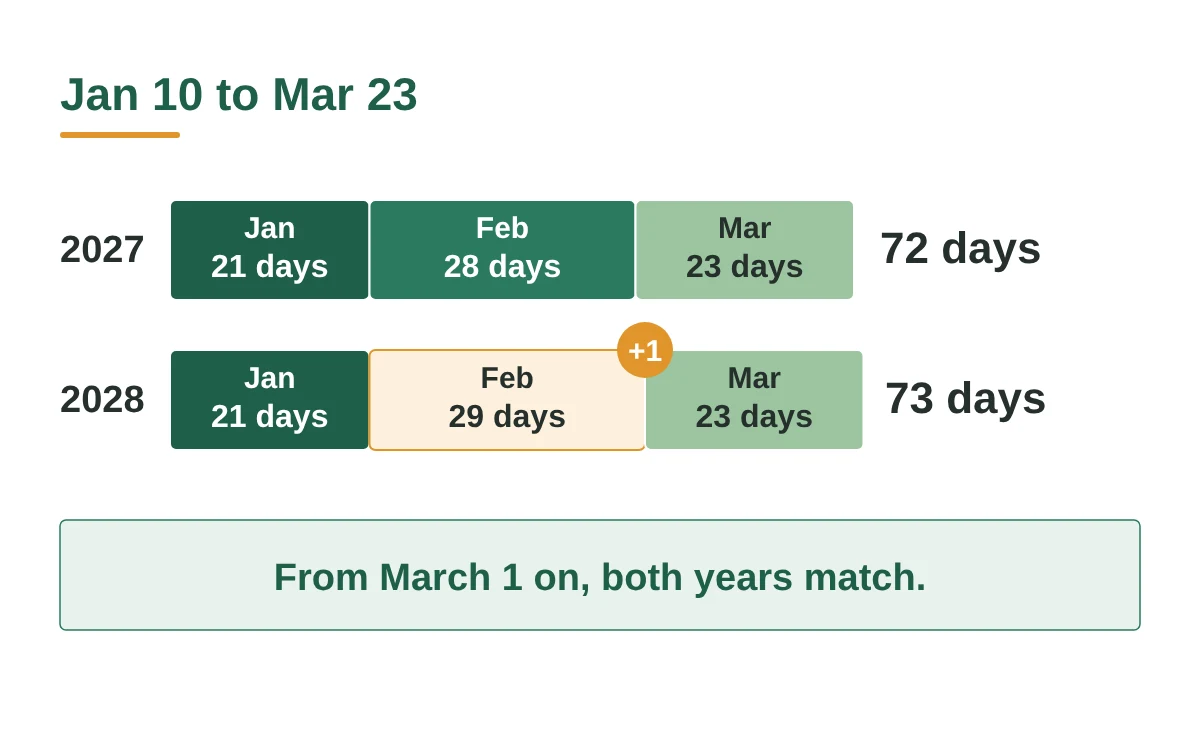
Day-of-year numbers make this a one-step subtraction. In a common year, March 23 is day 82 (31 for January, 28 for February, plus 23). In a leap year it is day 83. Find the start date’s day number and subtract.
Take a purely hypothetical start of January 10 in a common year. January 10 is day 10, so 82 minus 10 gives 72 days. The long way agrees: 21 days left in January, 28 in February, 23 into March, and 21 + 28 + 23 = 72. In a leap year the same start gives 73.
The leap-year trap only applies to starts in January or February. From March 1 onward, the extra day sits behind you, so leap and common years give identical results. For other starting points, the date calculator does the subtraction and handles the leap rule for you.
Counting weekdays and full weeks
Weekday counts are easy to get wrong because the leftover days after whole weeks matter. Divide the total by 7, multiply the whole weeks by 5, then walk through the leftover days one at a time, checking whether each lands on a weekday.
Continue the hypothetical: 72 days from a Sunday start is 10 whole weeks plus 2 extra days. Ten weeks hold 50 weekdays. The two leftover days are the Monday and Tuesday, so the total is 52 weekdays, with the target day included. Shift the start to a Friday and the same 72 days would give 51 instead.
Keep in mind that weekday counts ignore public holidays. If part of your span includes Easter or a spring bank holiday, subtract those separately. For week-based planning, 8 weeks is 56 days, which is a useful block for marking milestones backward from the date.
Try this: Pick any start date and estimate the days to March 23 by subtracting day-of-year numbers in your head. Then compare with the widget. If you are off by exactly one, you counted an endpoint.
What March 23 is known for
March 23 is World Meteorological Day, which marks the date in 1950 when the World Meteorological Organization’s convention came into force. It is also Pakistan Day, recalling the Lahore Resolution of 1940 and the 1956 constitution, and Bolivia observes the Day of the Sea (Día del Mar) on this date. In the United States, it is widely marked as National Puppy Day, an informal observance rather than an official holiday.
In history, March 23, 1775 is the date of Patrick Henry’s “Give me liberty, or give me death” speech in Virginia.
None of these is a public holiday in most countries, so a normal working day is the default. Check local rules if you are planning around Pakistan.
Where March 23 sits in the calendar
March 23 lands just after the March equinox, which falls on March 19, 20 or 21, so it is reliably the first week or so of astronomical spring in the Northern Hemisphere and autumn in the Southern. Looking at a neighbouring date helps if you are comparing: March 21 is the usual equinox neighbour.
It is also a possible Easter Sunday. Easter can fall as early as March 22, so March 23 sometimes carries it (it did in 2008). Good Friday and the Easter Monday that follow can pull school and office closures into the surrounding days, which is worth checking before you commit to dates.
Clock changes rarely interfere. US daylight saving begins in the second week of March, so it has already happened. The EU and UK switch on the last Sunday of March, which cannot come before the 25th, so a European countdown to March 23 never crosses a clock change that year.
The weekday pattern across years
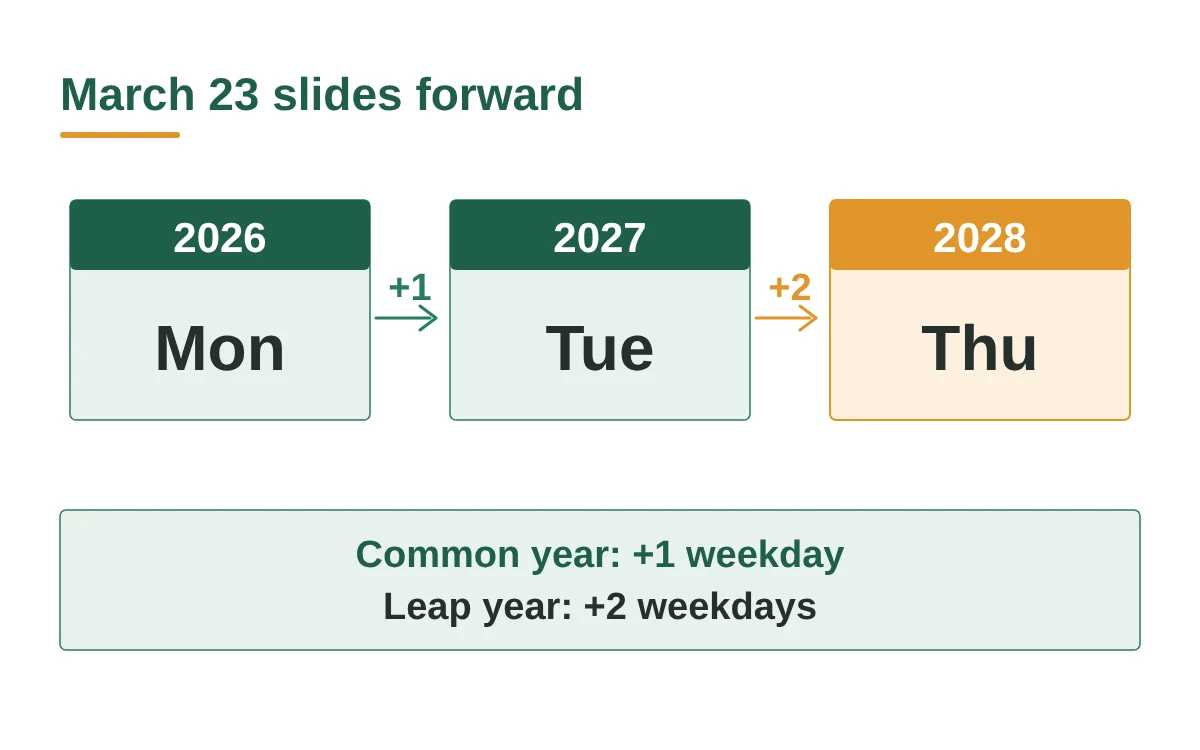
March 23 moves forward one weekday each year, and two weekdays after a leap day. So a Monday in one year becomes Tuesday the next, then Thursday the year after (because February 29 intervenes). That is why a date that was a weekend one year can be a working day the next.
This matters for anything you schedule yearly around March 23. A weekly rhythm will not line up from year to year, but the calendar position (day 82 in common years) does stay constant.
Planning around the countdown
A date this early in the year works well as a checkpoint for goals, since it closes out most of the first quarter. Three ways to use the gap:
- Split the remaining days into equal blocks and set one milestone per block.
- Work backward from March 23 with fixed lead times, such as 30 or 90 days ahead. The 90 days from now page helps find those anchor dates.
- Compare against nearby fixed dates, like March 31 at quarter end or April 15 for US tax filing.
Travel and event bookings often open exactly 90 or 180 days out, so the lead dates come before the countdown reaches single digits.
Try this: Choose one task you want finished by March 23. Divide the days left by four and write the four checkpoint dates on a calendar today.
Reading the live widget correctly
The widget counts to the start of March 23 in your local time, so the “days” figure drops at local midnight and the remaining hours run down to the same moment. If you are travelling, or your device clock is set to a different zone, the number will follow that setting rather than where the event is held.
For an event that happens at a specific time on March 23, use the time-of-day tools instead. The time until section covers that, and how long until midnight is handy for the last stretch.
Frequently asked questions
How many days until March 23?
The live widget at the top of this page gives the exact figure for your own clock and time zone. It always targets the next March 23 that has not yet started, so it rolls to the following year after the date passes.
Is March 23 in a leap year different to count?
Only if your start date falls before February 29 of that year. Then the span is one day longer. From March 1 onward, leap and common years give identical counts.
What day of the week is March 23?
It changes every year. The weekday moves forward one day each year, or two days when a February 29 has passed since the last one. After 28 years in the same century the cycle repeats.
Do I count today when counting days until March 23?
The standard method excludes the start day and includes the target day, which equals simple subtraction of day-of-year numbers. Count today as well and you get one more, which is how some sites end up a day apart.