
How Many Days Until March 18th?
Calendar
Countdown chart
The live counter above gives the exact answer for your own clock and time zone, and it always aims at the next March 18. It counts down to the first moment of that date, so on the morning of March 18 itself the number reads zero days, not one.
The rest of this page covers what the counter cannot show: how to check it yourself in under a minute, why the hours figure can look off by one, and how to turn the date into a weekday count you can plan around.
What the counter is actually measuring
A countdown to a date is a countdown to midnight at the start of that date. If your event happens at 7 PM on March 18, the real wait is the displayed time plus 19 hours. Anyone who needs “days until the day” should read the day figure; anyone who needs “time until the event” should use a time-of-day countdown instead, such as how long until 3 PM or similar.
Time zones matter only near the edge. Someone in Sydney reaches March 18 many hours before someone in Los Angeles, so the same moment can show different day counts on two screens. The widget uses your device clock, which is what you want unless you are counting for someone elsewhere.
Counting by hand with the day-of-year trick
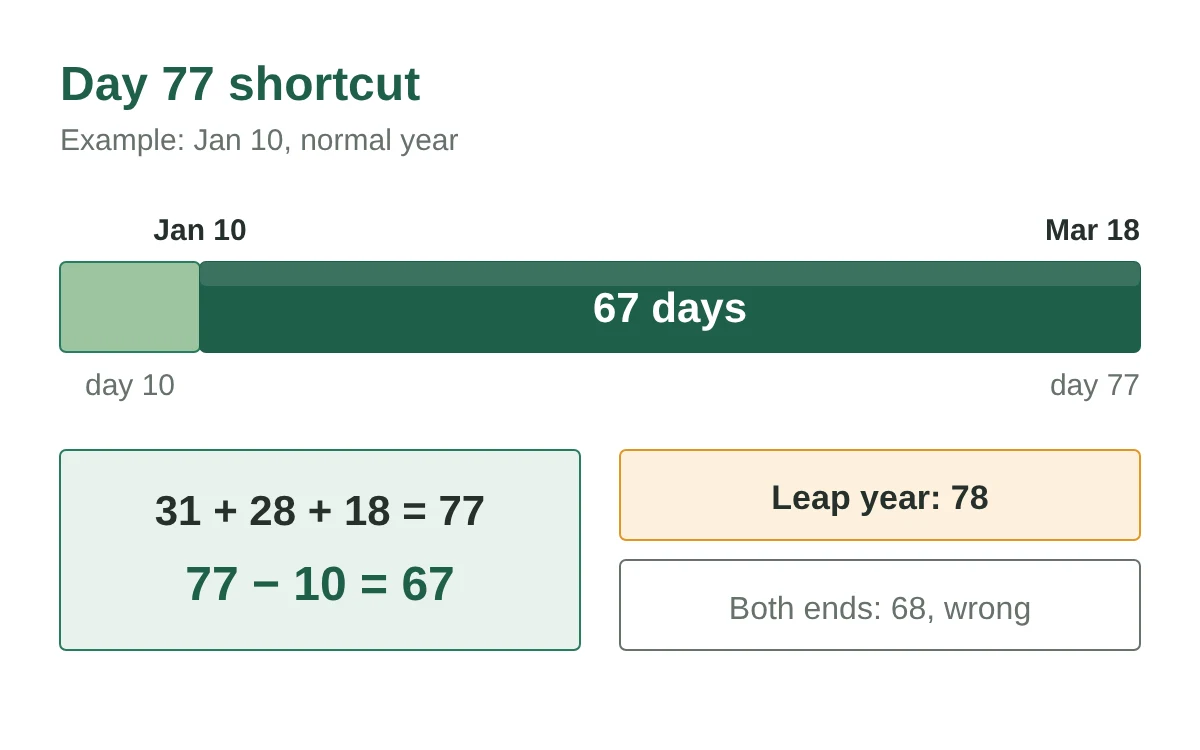
The fastest manual method skips month-by-month addition. March 18 is day 77 of a normal year (31 + 28 + 18) and day 78 in a leap year. Find the day number of your start date, subtract it from 77, and you have the answer.
Worked example with a made-up start date of January 10 in a normal year: January 10 is day 10, so 77 minus 10 gives 67 days. The long way agrees: 21 days left in January, 28 in February, plus 18 in March is also 67.
The classic mistake is counting both ends. Counting from January 10 to March 18 as if both days were included gives 68. Pick one convention and stick to it. The counter excludes the start day and lands on the target day, which matches how most people say “days until”.
Try this: Pick any date within the next three months, work out its day-of-year number from memory (the month starts in a normal year are 0, 31, 59, 90, 120, 151, and so on), then subtract it from 77. Check the answer against the widget.
The daylight saving trap in the hours figure
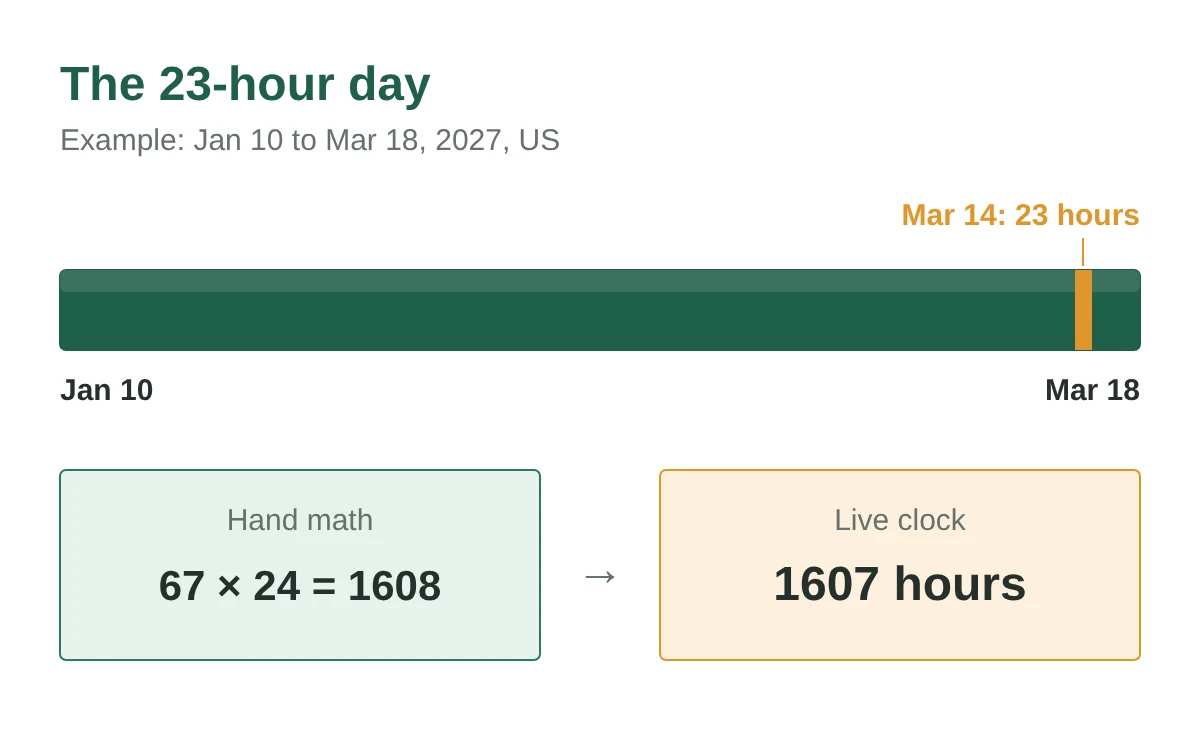
In the United States, clocks spring forward on the second Sunday in March. That falls before March 18 every year, which means any countdown that starts before the change and ends at the beginning of March 18 contains a 23-hour day. The hours figure then equals days times 24, minus one.
Nothing is wrong with the day count here. Only the conversion from days to hours breaks, and that is why a hand-multiplied total sometimes disagrees with a live clock by exactly 60 minutes. Europe changes later, on the last Sunday of March, so a countdown in London or Berlin ending on March 18 does not cross the change. If your plan spans the switch, March 14 is a useful neighbour to check in some years.
Which weekday March 18 lands on
The weekday moves forward one step each year, and two steps when a February 29 sits in between. That gives a predictable run: Thursday in 2027, then Saturday in 2028, Sunday in 2029, Monday in 2030, Tuesday in 2031 and Thursday again in 2032.
The pattern means March 18 is a school or workday in some years and a weekend in others, so the countdown to it can be a weekday deadline one year and a lazy Saturday the next. If a plan depends on the date being a working day, check the year, not just the number.
Counting weekdays without a calendar
Divide the day count by 7. The whole weeks each contribute exactly 5 weekdays, and the leftover days need a quick look at the calendar. Using the earlier example of 67 days from a Sunday, January 10: nine full weeks give 45 weekdays, and the 4 leftover days run Monday to Thursday, adding 4 more.
- Including March 18 itself, that is 49 weekdays.
- Excluding it, 48.
- Public holidays in between still need to be subtracted by hand.
The remainder also predicts the weekday. The 4 leftover days move the start day (Sunday) forward to Thursday, so the remainder is a free check on the date’s weekday. Different sites quote different weekday totals for the same date mostly because of the including or excluding choice, not arithmetic errors.
Try this: Take the widget’s day count, divide by 7, and note the remainder. Add that remainder to today’s weekday. It should land on the weekday of March 18 for the year shown.
What March 18 is known for
March 18 has no widely observed public holiday in the United States, but it carries plenty of dates elsewhere. March 18 is National Anthem and Flag Day in Aruba, commemorating the adoption of both in 1976. Mexico marks the Anniversary of the Oil Expropriation on this date, and Syrian Revolution Day is a public holiday in Syria.
On the lighter side, Global Recycling Day is celebrated annually on March 18, National Biodiesel Day falls on Rudolf Diesel’s birthday (born in 1858), and National Sloppy Joe Day and Awkward Moments Day also land here. The day after St. Patrick’s Day is also Sheelah’s Day in Irish folk tradition.
In history, cosmonaut Aleksei Leonov took the first spacewalk from Voskhod 2 on March 18, 1965. Many of these observances are informal, so treat the national “food days” as fun rather than official.
Planning around the date
March 18 sits two days before the spring equinox (usually March 20 or 21), so it works as a natural “last winter week” marker. If you are counting toward the equinox itself, March 21 is the better target. If the count is a deadline for a project, work backward by blocks: a 90-day lead time, for example, can be mapped with what is 90 days from now.
For events, the Wednesday and Thursday around March 18 often clash with St. Patrick’s Day celebrations the day before, so book venues early. For personal goals, splitting the remaining weeks into equal checkpoints works better than a single date, since most people lose momentum in the middle third. To compare with other dates, the date calculator finds the gap between any two days.
What happens after March 18 passes
The widget does not stop at zero. Once March 18 arrives, it rolls to the next year’s date, so the number jumps back up to roughly 365 (or 366 when a leap year’s February 29 falls in between). That sudden jump is the most common source of “the counter is broken” reports, and it is the intended behaviour.
If you need a countdown to one specific year rather than the next occurrence, use the date calculator with the full date entered, or browse all date countdowns for a fixed-year version.
Frequently asked questions
Why does the countdown to March 18 show zero days on March 18 itself?
The counter aims at the first moment of the date, which is midnight at the start of March 18. Once that moment arrives, zero days remain, even though the whole day is still ahead. For an event later that day, add the hours until its start time.
Why can the hours until March 18 be one hour less than days multiplied by 24?
In the US, clocks spring forward on the second Sunday of March, always before March 18, so a countdown crossing that change includes a 23-hour day. The day count stays correct and only the days-to-hours conversion shifts by 60 minutes. Europe changes on the last Sunday of March, so countdowns there ending on March 18 are not affected.
How can the days until March 18 be calculated by hand?
March 18 is day 77 of a normal year and day 78 in a leap year. Find the day-of-year number of the start date and subtract it from 77 (or 78). This gives the same result as counting the remaining days month by month, and it excludes the start day.
How can the number of weekdays until March 18 be worked out without a calendar?
Divide the day count by 7, multiply the whole weeks by 5, then count the leftover days against the calendar to see how many are Monday to Friday. Whether March 18 itself is included changes the total by one, and public holidays must be subtracted separately.